Most of what a cooling tower owner has to do in a given year isn't complicated on its own — it's just spread across several rules, two agencies, and a calendar that doesn't line up neatly with a lease year or a fiscal year. Here's the full cycle in one place.
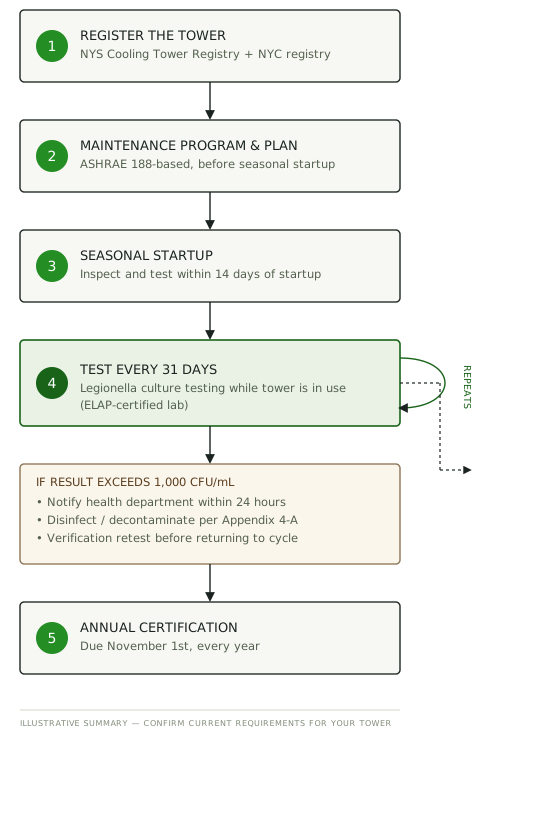
1. Registration
Every cooling tower in New York State has to be registered in the NYS Cooling Tower Registry, and towers in NYC also need to be registered in the City's own registry.[1] Registry records need to be kept current — not just filed once and forgotten.
2. Maintenance program & plan
Before a tower's first startup, and kept current after that, owners need a written maintenance program and plan built around ASHRAE Standard 188.[2] This is the document that lays out routine sampling schedules, the conditions that trigger extra testing, and what happens if something goes wrong — it's not just paperwork, it's the operating manual regulators expect you to actually be following.
3. Seasonal startup
Bringing a tower back online for the season isn't just a valve to open. It needs an inspection, and a Legionella culture test within 3 to 14 days of startup.[3]
4. Testing every 31 days
This is the cycle that changed in May 2026 — testing now happens every 31 days while a tower is in use, citywide, instead of every 90.[4] Every sample goes through an ELAP-certified lab. This is the loop that runs for as long as the tower operates each season.
5. If a result comes back elevated
A result at or above 1,000 CFU/mL triggers a 24-hour clock: the local health department has to be notified.[5] From there, disinfection or decontamination follows a specific protocol depending on severity — and critically, a verification retest afterward is what actually confirms the treatment worked, before the tower goes back to its normal testing cycle.
6. Biannual certification
Separate from the ongoing testing cycle, every registered tower now needs a certification twice a year — filed in January and July — attesting that the maintenance program and plan is in place and has actually been followed since the last filing. This replaced the old once-a-year, November 1st filing under Chapter 206 of the Laws of 2026. See our full breakdown of the new law for what else changed.[6]
Where this gets missed
In practice, the two places we see owners fall behind are the 31-day cadence itself — easy to miss once a season gets busy — and treating the verification retest as optional after a cleaning. It isn't: without it, there's no documented confirmation that a decontamination actually worked.
If you want help with any single piece of this — or the whole cycle — see our cooling tower compliance services.
Sources
- NYS Dept. of Health, 10 NYCRR Subpart 4-1 (cooling tower registration); NYC Health Code Article 8 (City registry).
- 10 NYCRR §4-1.4 — maintenance program & plan requirements, referencing ANSI/ASHRAE Standard 188.
- NYC Dept. of Health and Mental Hygiene, cooling tower compliance guidance — seasonal startup testing window.
- NYC Local Law 159 of 2025 (eff. May 7, 2026), amending the Legionella testing interval; NYS DOH Environmental Laboratory Approval Program (ELAP).
- NYC Health Code Article 8, Table 8-1 — exceedance response & notification threshold.
- A9058-A / S8472-A (Chapter 206 of the Laws of 2026), amending NYC Administrative Code §28-317.5 to require biannual certification, filed in January and July.